Mini Series: Why chips are the new oil
20th, February, 2026
In this mini-series on the New World Order, we explore the forces reshaping global power.
In today’s world, where everything runs on technology, semiconductors have become the new oil.
Just like the oil crises of the 1970s, the world only notices their strategic importance when supply disappears.
Take 1973. During the Yom Kippur War, Arab oil producers cut supply to nations supporting Israel. Oil didn’t vanish—it was deliberately restricted.
The result? Prices quadrupled. Fuel lines formed. Inflation surged. Economies slid into recession.
Overnight, oil went from a cheap commodity to a strategic weapon.
The lesson was simple: control critical inputs, and you control economic power.
Fast forward to COVID-19. The shock wasn’t oil. It was semiconductors.
Factories shuttered. Cars sat idle. Supply chains froze. Governments realised something uncomfortable: advanced chips are just as concentrated, just as fragile, and just as strategic as oil once was.
And they realised something else: advanced chips are no longer just commercial assets—they’re strategic weapons.
Think about it. Semiconductors sit at the heart of everything: AI, cloud computing, defence systems, EVs, smartphones, industrial automation. Without them, modern economies don’t function.
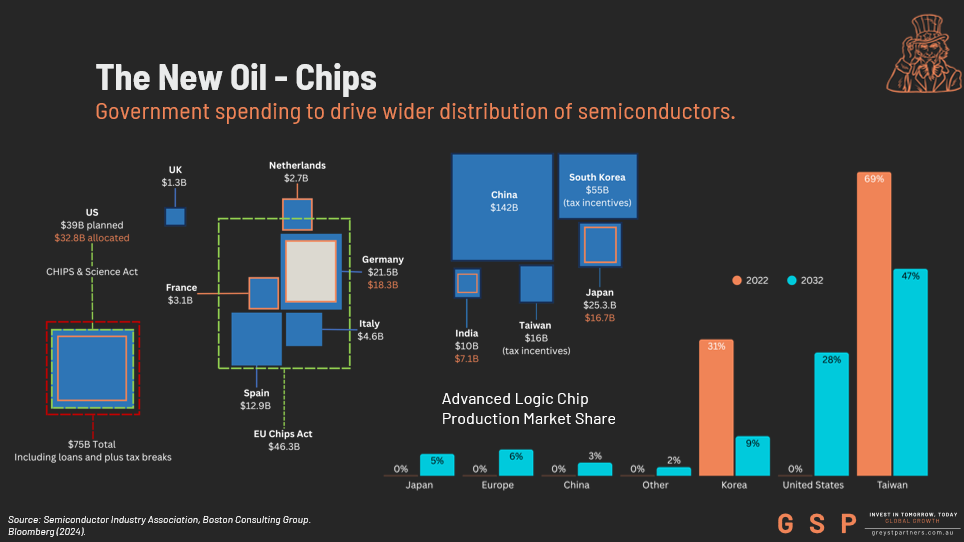
That’s why governments are stepping in like never before.
The US launched the CHIPS & Science Act.
Europe followed with the EU Chips Act.
Japan, Korea, and Taiwan expanded subsidies and tax incentives to boost chip manufacturing.
But the biggest imbalance is in China.
China imports roughly 70% of the chips it uses, represents 60% of global semiconductor demand, yet manufactures only around 13% of supply.
This gap is a strategic vulnerability, and Beijing is responding. Under Made in China 2025, China has committed over US$50 billion to build domestic semiconductor capabilities.
This isn’t just about technology—it’s about sovereignty, resilience, and power.
Just as oil defined the last century, semiconductors are shaping this one.
Whoever develops the best chips wins the AI race, and whoever wins the AI race wins the century—because in an aging population, productivity is everything.