

In the Press - Ausbiz TV: LATAM Digital Banking
18th February, 2026
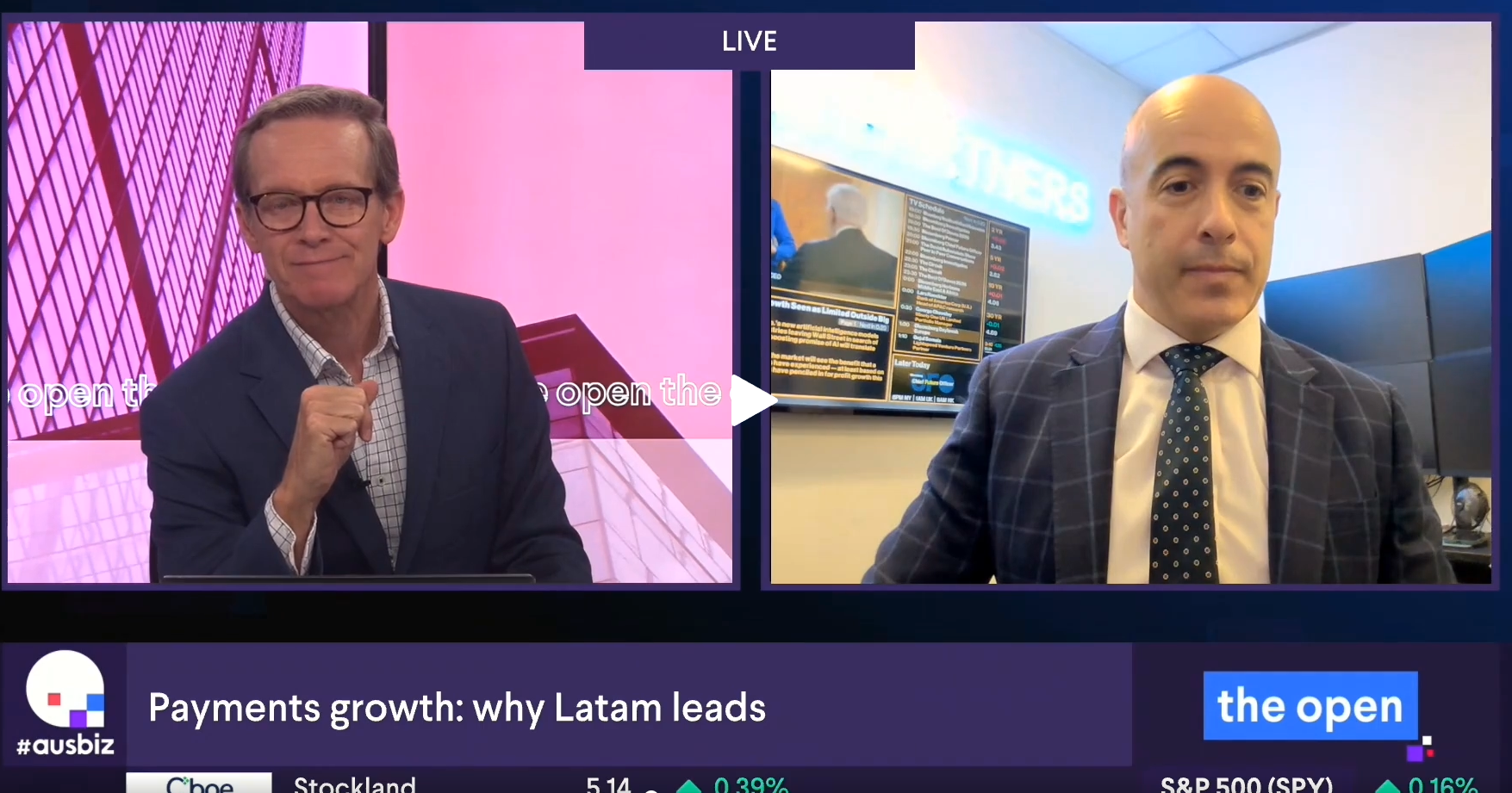
Huw Davies, Portfolio Manager, joined Ausbiz TV to discuss the rapid digital transformation of Latin America’s financial system, the rise of mobile-first banking, and why platforms like Nubank and MercadoLibre are positioned to benefit from expanding financial inclusion and e-commerce over the next decade.
What’s happening in Latin America isn’t just fintech disruption.
It’s financial inclusion at scale.
And it’s being powered by one device: The smartphone.
From Cash to Code
For decades, Latin America was defined by:
High cash usage
Large unbanked populations
Low trust in traditional banks
High account fees
Limited branch access
The system wasn’t broken.
It was incomplete.
Today, mobile-first platforms are filling that structural gap.
Latin America has roughly 550–600 million people — expanding to nearly 670–680 million including the Caribbean.
That’s an enormous addressable population.
And mobile technology is leapfrogging legacy banking infrastructure entirely.
This isn’t fintech taking share from incumbents.
It’s fintech creating entirely new participants in the financial system.
Commerce and financial services are converging into platform ecosystems.
The Global & Regional Payments Shift
The macro backdrop matters.
Globally:
Cash now accounts for roughly 46% of payments, down from 50% just a few years ago.
Digital wallets represent about 30% of point-of-sale transactions, forecast to approach the mid-40% range by 2027.
Digital payments are projected to exceed US$3 trillion by 2028.
In Latin America specifically:
Payments revenue grew around 11% in 2024 — above the global average.
QR adoption is accelerating.
Real-time payment rails like PIX in Brazil are reducing friction and merchant costs.
The direction is clear:
Cash is declining.
Digital rails are scaling.
And the shift is structural.
Smartphones: The Real Infrastructure
At the centre of this transformation is smartphone penetration.
Across Latin America:
Smartphone adoption has grown from roughly 44% in 2015
To about 83% in 2025
Forecast to reach over 90% by 2030
Major markets like Brazil are expected to approach 95%.
Why the surge?
Expansion of 4G and 5G networks
A rapid increase in mobile broadband subscriptions
Affordable mid-range devices from companies like Xiaomi and Samsung
Urban populations (~80% of LATAM) that adopt digital services quickly
For millions of consumers, the banking app is now their primary financial interface.
There was never a need to build physical branch density.
Mobile became the branch.
The Unbanked Opportunity
Latin America still has over 100 million unbanked or underbanked individuals.
In key markets:
Mexico: ~51% underbanked
Colombia: ~54%
Peru: ~51%
Brazil, Mexico, and Colombia alone account for over 70% of regional GDP.
This is not a saturated market.
It is underpenetrated.
Digital onboarding and low- or no-fee accounts are bringing users into the formal financial system for the first time.
And here’s the crucial distinction:
This is system expansion.
Not zero-sum disruption.
The total addressable market is growing as new consumers enter the ecosystem.
The Banking & Commerce TAM
The numbers are substantial:
Retail banking revenue in LATAM reached approximately US$221 billion in 2024
Projected to grow toward US$355 billion by 2033
Drivers include:
Underpenetrated credit markets
Low household financial product density
A rising middle class
Rapid e-commerce adoption
LATAM e-commerce is approaching US$215 billion by 2026 — growing faster than global averages, largely driven by mobile and digital payment adoption.
And here’s where it compounds:
Marketplace activity increases transaction frequency.
Payments increase engagement.
Digital wallets enable data collection.
Credit expands monetisation.
Financial services deepen ecosystem lock-in.
It becomes a flywheel.
The convergence of banking and e-commerce dramatically expands the total market opportunity.
The Two Archetypes: Nubank & MercadoLibre
Two companies illustrate this structural shift.
Nubank (NU)
~120 million customers
~105M in Brazil
~11M in Mexico
~3M in Colombia
Fully digital.
Mobile-first.
Low-cost operating model.
Products span:
Accounts
Credit cards
Personal loans
Insurance
Investing
Marketplace services
Fee-free accounts and instant transfers make banking accessible to populations previously excluded.
Mexico and Colombia represent the next growth frontier.
The growth equation is straightforward:
Untapped markets + cross-selling + product expansion
→ Higher ARPAC (Average Revenue Per Account)
→ Higher earnings
→ Operating leverage over time.
MercadoLibre (MELI)
The dominant regional e-commerce platform.
Through Mercado Pago, it embeds finance directly into commerce:
Digital wallets
QR payments
SME lending
Consumer credit
Its marketplace drives transaction frequency.
That fuels financial engagement and data collection.
That enables credit expansion.
That increases ecosystem lock-in.
It’s a self-reinforcing loop.
Importantly, both models can win.
Because the market is so underpenetrated.
The Bigger Picture
Latin America is leapfrogging traditional banking models.
It is digitising rapidly.
It is expanding financial access.
Rising smartphone penetration.
Instant payment rails.
Young populations.
Low financial product density.
This is a multi-year structural story.
Companies like Nubank and MercadoLibre sit at the centre of the commerce-finance convergence.
Digital finance in LATAM isn’t just disruptive.
It’s additive.
It is building a larger financial system — not simply reshuffling the old one.
And that distinction matters.