

August Update
August reversed July. Growth and technology recovered, energy stayed in the lead, and a hawkish Jackson Hole speech took some of the gloss off into month-end.
US equities posted their strongest August since 2021. The S&P 500 rose 2.7% and the Nasdaq 100 gained 4.2%, both finishing near record levels after a mid-month peak. The Dow added about 1.5%. Small caps lagged the rebound: the Russell 2000 rose roughly 1%, though it remains up about 20% year-to-date, ahead of both the S&P 500 (about 13%) and the Nasdaq 100.
Leadership was wider than the headline indices suggest, but not uniform. The S&P 500 Equal Weight Index gained about 2.1% and is up around 15.6% year-to-date, ahead of the market-cap weighted index. Only about half of S&P sectors finished higher. Energy led again, up around 7%, extending a year in which oil has been the dominant sector story. Technology rose about 6.2%, materials about 6%, and healthcare close to 5%. Utilities and industrials lagged as bond yields pushed higher late in the month.
The tape had two halves. Softer July jobs data and cooler inflation early in the month eased fears of another Fed hike and carried equities to fresh highs. That mood reversed at Jackson Hole. Chair Kevin Warsh reiterated the 2% inflation target and warned that recent softer prints may not mark a genuine turn in the trend, with inflation still running well above target. Hike odds for September jumped, the two-year yield rose, and the 10-year finished near 4.75%. Equities gave back some of the mid-month gains, but did not unwind the recovery.
Oil and hard assets told a separate story. Renewed tension around the Strait of Hormuz kept crude supported, with WTI finishing near $86 and Brent back above $90. Gold rose roughly 9–10% and silver more than that. The debasement trade and the growth rebound ran together for most of August, then rates did the trimming.
Software, and the AI debate
The more important shift for growth investors was in software. July had been defined by a sharp rotation out of technology and a market that was pricing AI as a threat to incumbent platforms. August walked a good part of that back.
Palantir was the clearest example. Shares rose from $123.06 at the end of July to $186.38, about 51%, after a second-quarter result that showed the AI platform moving from pilots into scaled deployment. Revenue rose 93% year-on-year to $1.94 billion. US commercial revenue rose 149% to $764 million, US government revenue rose 90%, and full-year revenue guidance was lifted to about $8.15 billion, implying roughly 82% growth.
ServiceNow followed the same script. Subscription revenue grew 24.5%, AI-related annual contract value passed $1 billion, and agentic deployments rose ninefold in nine months. Later in the month Salesforce and CrowdStrike added to the evidence, and the software complex rebounded hard. Nvidia’s result, with a guide that hyperscaler spending is still accelerating, reinforced the other side of the same trade: the infrastructure is being bought because customers are already trying to use it.
Airbnb was a useful counterpoint outside the software complex. Bookings growth accelerated in both core and expansion markets, management lifted the full-year revenue outlook to mid-teens, and early evidence suggested its own AI spend was lifting conversion and service efficiency rather than being disintermediated by generative tools.
The conclusion is narrower than the headlines. AI is not a blanket positive for every software model, and it is not a blanket threat either. Businesses with proprietary workflow data, distribution and a credible path to monetising agents were repriced higher. The ones without that path were not.
Can the capex earn a return?
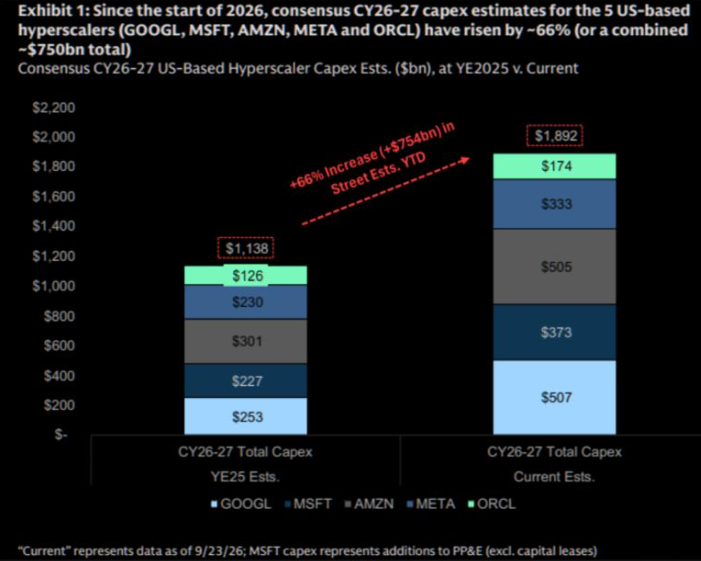
The other question the month left open is no longer how much the hyperscalers will spend. It is whether they can earn a return on it.
Goldman Sachs’ Eric Sheridan estimates that Alphabet, Amazon, Microsoft, Meta, Oracle and SpaceX need to generate a combined $1.42 trillion of cumulative revenue in 2028–30 to earn a 15% return on invested capital on their 2026–27 AI buildout. That is a large number. It is also a more useful one than the capex headlines, because it can be set against demand that is already contracted.
The three big public cloud players, Amazon, Microsoft and Alphabet, already have a combined backlog of $1.69 trillion, up about 150% year-on-year. On Goldman’s framework, they need to convert only around 59% of that existing backlog into future revenue to clear the 15% hurdle on their own AI investment. Capacity, not orders, is the constraint management teams keep citing.
That does not make the spend riskless. Depreciation is front-loaded, power and component costs are real, and not every dollar of backlog converts at the same margin. It does change the shape of the debate. A large share of the revenue required to justify the buildout is already sitting in the order book, which is a different problem from hoping the demand turns up later.
How we are thinking about it
August did not resolve the tension in this market. Earnings breadth is better, small caps and equal-weight indices are ahead year-to-date, and energy has been the standout sector. A hawkish Fed, oil above $85 and long-bond yields near their highs of the cycle remain a constraint on duration.
On AI, the software rebound is not an all-clear, and the capex numbers are not self-justifying. The useful test is whether the spend is meeting contracted demand and showing up in revenue, backlog and cash generation. On that test, August was more constructive than July.
This is general information only and does not take into account your objectives, financial situation or needs. Past performance is not a reliable indicator of future performance. Goldman Sachs estimates as cited; not a recommendation.