

1st December, 2025
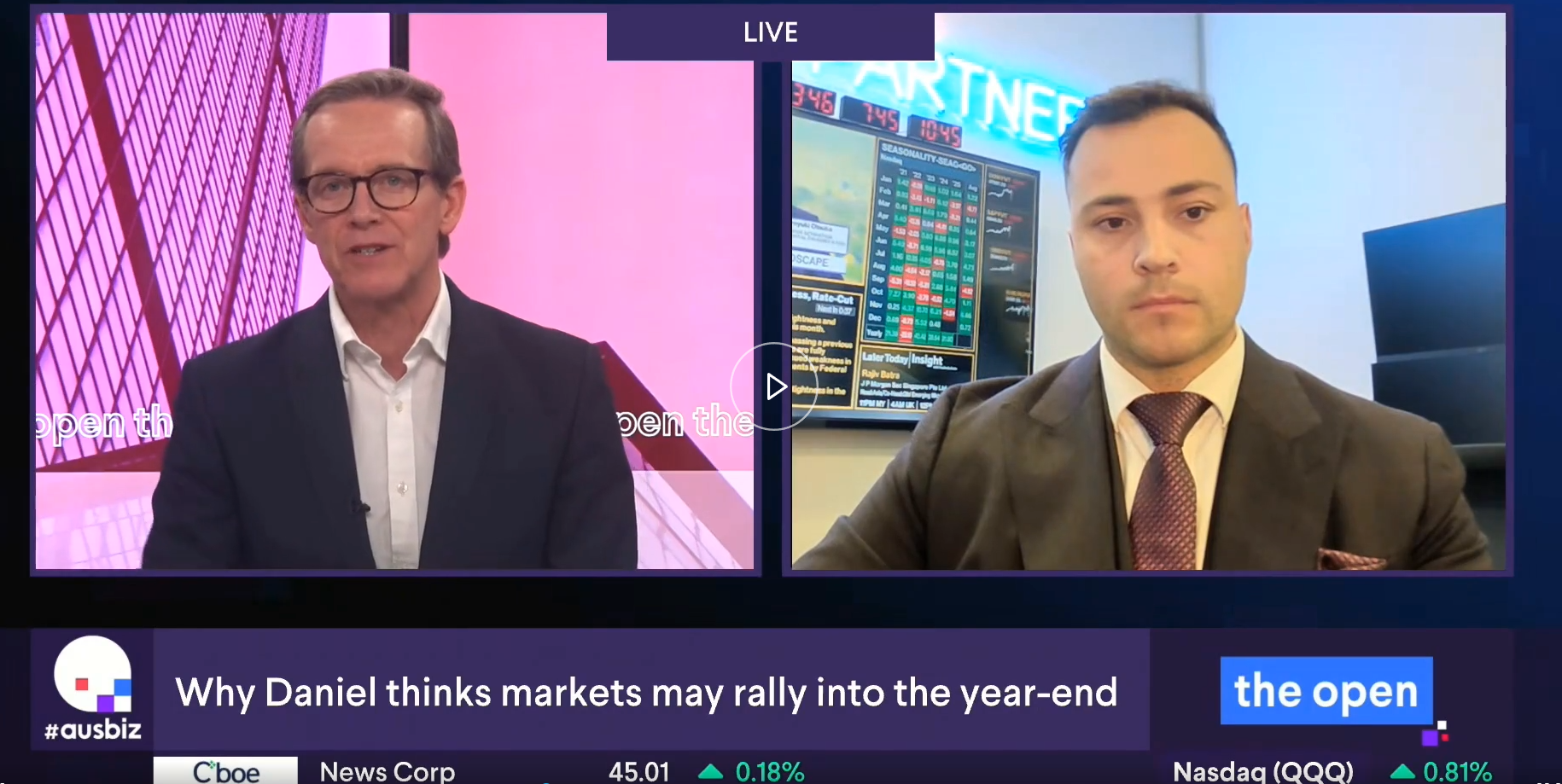
Daniel Reaper, Portfolio Manager, joined Ausbiz TV to unpack the catalysts that could drive a potential year-end rally, from rate-cut expectations and an oversold market setup to strengthening seasonality and a broader pickup in investor confidence. He also explored the renewed momentum behind the AI trade, noting the intensifying rivalry between Google and Nvidia as the next major battleground set to shape market sentiment.
Watch Video: Who will be crowned the AI king?
Year-End Market Rally: Catalysts Align as AI Momentum Accelerates
As we roll into December 2025, the financial markets are buzzing with optimism. After a turbulent stretch marked by political gridlock and economic jitters, the S&P 500 has clawed back. This isn't just seasonal cheer, it's a confluence of resolved uncertainties, accommodative policy signals, and a resurgent AI narrative that's putting risk assets back in the driver's seat.
The US Government Shutdown Is Finally Over
The 43-day federal shutdown, the longest in US history, wrapped up in mid-November after a bipartisan deal unlocked funding. This dragged on from early October, freezing economic data releases, disrupting air travel, and injecting massive volatility into everything from Treasury yields to corporate earnings calls. Air traffic plummeted as TSA staffing cratered, and the backlog of reports (think jobs data and inflation prints) created a fog of doubt.
Markets despise uncertainty, and its removal is a green light for risk-on behavior. With federal workers back on payroll and data flowing freely again, investor confidence is rebounding fast. Expect this tailwind to support a broad-based rally, especially in cyclicals hit hardest by the impasse.
December Rate Cut: Virtually Done Deal
Just over a month ago, odds of a Federal Reserve rate cut on December 18 had nosedived from 90% to around 30% amid shutdown-induced noise. Fast-forward to now, and the CME FedWatch Tool shows an 87% probability of a 25 basis-point trim. The underlying data never wavered: September's CPI flashed deflationary signals in core components, the labor market showed softening without cracking, and shutdown fallout amplified travel and spending weakness, all pointing to no imminent inflation rebound.
The Fed's "All-Clear" Signal
Two cuts down, one to go: This sequence mirrors the Fed's playbook from 1998 and earlier in 2024, where three easing steps over four months ignited S&P 500 to year-end highs. No recession in sight, just more fuel for multiple expansion. With inflation tamed and growth steady, the Fed's pivot removes the biggest overhang on valuations.
Markets Were Screaming Oversold
Mid-November saw the S&P's RSI dip to 35, textbook oversold territory after a sharp pullback. Cue the sideline cash and short-covering, it was the perfect buy the dip reflex that has played out.
Seasonality: The Ultimate Tailwind
History doesn't lie. Since 1950, when the S&P is up 10%+ through October (as it was this year), November and December have averaged +3.3% gains. Narrow it to the post-1980 era, more akin to today's low-rate, tech-heavy world and it's +4.9%. With these macro boxes checked, the stars are aligned for Santa's rally to deliver.
AI Thematic Locked In: NVIDIA's Earnings Seal the Deal
If there was any doubt about AI's staying power, NVIDIA's Q3 fiscal 2026 print on November 19 erased it. The chip king reported record revenue of $57 billion, up 22% quarter-over-quarter and 62% year-over-year, smashing consensus on both top-line and EPS ($1.30 vs. $1.26 expected). Data Center revenue, a proxy for AI demand, hit $51.2 billion, surging 66% YoY as hyperscalers hoovered up Blackwell and Hopper chips.
Bulls breathed easy on forward guidance: Q4 revenue pegged at $65 billion (±2%), implying 50% YoY growth and well ahead of the $62 billion whisper number. CEO Jensen Huang doubled down, reaffirming $500 billion in AI chip orders locked for 2025-2026 (Blackwell + Rubin platforms), with potential upside as new deals roll in. Every cloud GPU is sold out, even legacy A100s, and supply constraints persist. Reports peg the demand-to-supply ratio at around 12:1 for NVIDIA GPUs, underscoring insatiable hunger.
Google vs. NVIDIA: The Hardware Arms Race Heats Up - Who is AI KING?
Markets love a kingmaker narrative, but AI's hardware battlefield is more nuanced than "NVIDIA forever." Remember 2023, when ChatGPT hype had folks writing Google's obituary? Turns out, Google's DeepMind labs birthed much of the foundational tech powering OpenAI. Fast-forward to 2025: The fight spans cloud (AWS, Azure, GCP + Oracle), software (Gemini vs ChatGPT), and crucially, chips from NVIDIA/AMD GPUs vs Google's TPUs.
Google’s TPUs and Nvidia’s GPUs are not the same thing.
GPUs are graphics chips that were built for gaming and computers, but NVIDIA pivoted them into AI via CUDA, a 20-year-old software stack that lets programmers/engineers treat them like programmable supercomputers, and as a result over 95% of AI research runs on NVIDIA because of it, created immense switching costs as it would mean rewriting massive codebases, a non-starter for most - this is NVIDIA’s wide moat.
Enter Google's TPUs: Built from scratch over a decade ago for hyperscale data centers, these ASICs (application-specific integrated circuits) are purpose-engineered for tensor math—the "fancy grid of numbers" at AI's core. Google's vertical stack (TPUs fueling Search, YouTube, Gemini) delivers killer efficiency: 2-4x better performance per dollar than NVIDIA's H100/B200, 2-3x per watt, and up to 70% cheaper for inference (the bulk of AI workloads by 2030). Newer gens like Trillium (v6) and Ironwood push this further, with 4x perf/dollar edges in inference vs. H100s.
So why not all-in on TPUs? CUDA's lock-in creates sky-high switching costs. But Google is chipping away, expanding TPU access via Cloud to outsiders. Meta and Anthropic are placing billion-dollar orders, building hybrid stacks around TPUs for cost savings. When we look ahead we see a "both/and" future: GPUs for flexible training, TPUs for scalable inference. Both win long-term, Google's already outrun NVIDIA from April lows, trading at a forward P/E premium, its going to be interesting to see how TPU hardware gets priced as we head into next year.