

In The Press - Ausbiz: Why Daniel is bullish on memory chips, hyperscalers & software
4th April, 2026
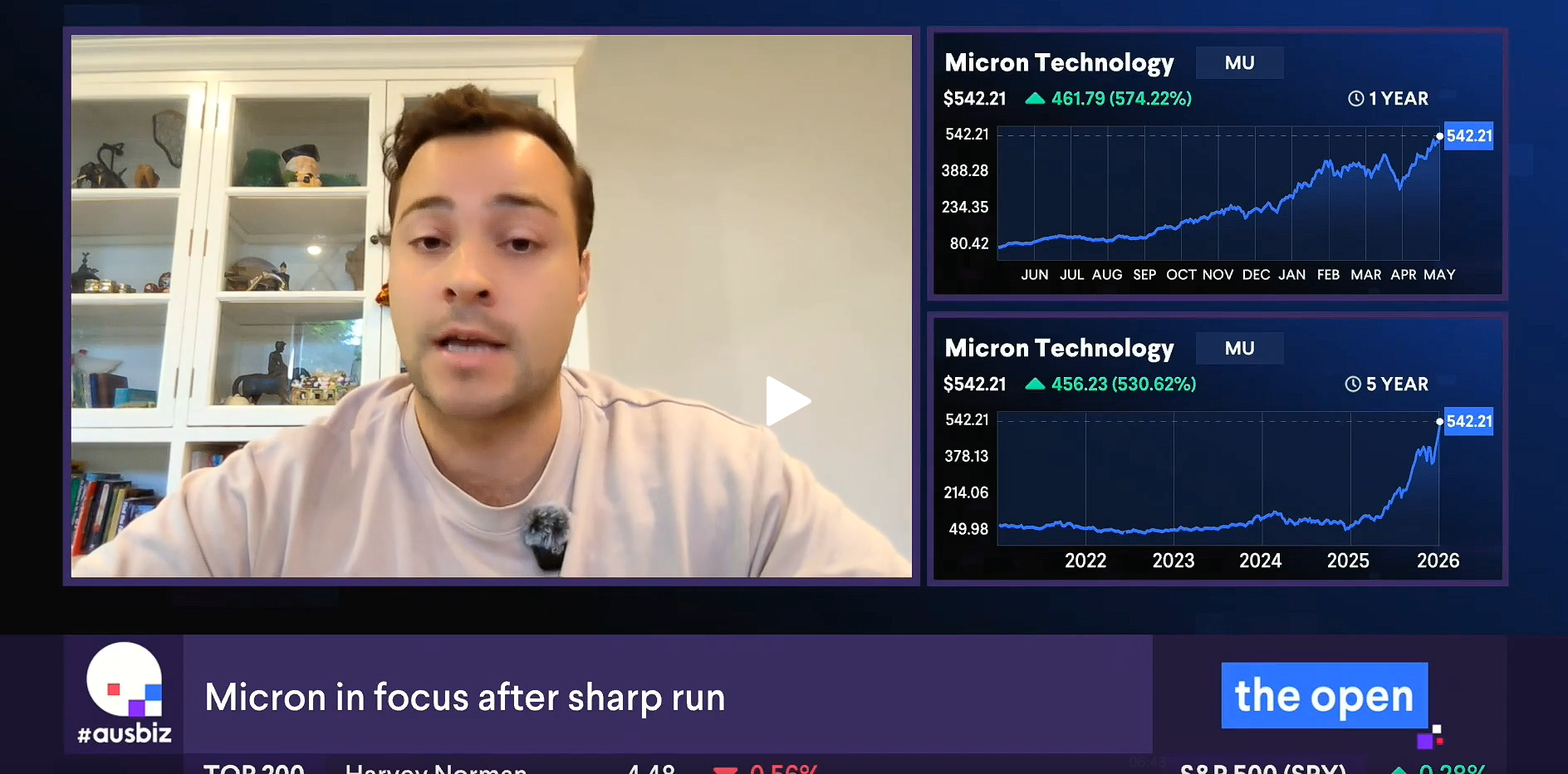
Daniel Reaper, Portfolio Manager, joined AusbizTV to discuss the hyperscalers’ record capital expenditure cycle, including more than US$570 billion in CapEx this year from the big3. Outlined the investment thesis on memory chips & why the portfolio holds Micron (MU); tight industry supply growth of only ~20% vs significantly stronger demand should support the upcycle well into 2027 and through 2028. The software recovery, fund flows into the thematic are increasing.
Watch Interview: Why Daniel is bullish on memory chips, hyperscalers & software on ausbiz
Record CapEx from the Hyperscalers
Microsoft, Amazon, and Alphabet alone are expected to deploy more than US$570 billion in capital expenditure this year. When you include Meta, the four largest hyperscalers are now guiding for well over $700 billion in combined CapEx for 2026 — a staggering increase from already record levels last year.
This is not speculative spending. It is the physical buildout of AI infrastructure at scale: data centres, power, networking, and — crucially — the memory and compute that sit at the heart of every AI training and inference workload.
The market has been fixated on whether this spending will deliver returns. What is often missed is that the spending itself is creating very clear, investable supply-and-demand imbalances in certain parts of the technology stack.
Memory Chips: The Picks and Shovels of the AI Era
High-bandwidth memory (HBM) has become the critical bottleneck in the AI supply chain. While everyone talks about GPUs, it is the memory that sits next to those GPUs that is currently in shortest supply.
We hold Micron (MU) in the portfolio and remain very bullish on the memory thesis. The upcycle looks set to extend strongly into 2027 and potentially through 2028. Industry supply growth is constrained to roughly 20% per year, while demand — driven by the hyperscalers’ buildout — continues to significantly outpace it.
Micron has already sold out its entire 2026 HBM production. New capacity from greenfield projects is not arriving in meaningful volumes until mid-2027 at the earliest, and in some cases 2028. This structural supply tightness, combined with multi-year contracts now being signed by the big cloud providers, gives the memory cycle unusual visibility and duration.
In short: the “picks and shovels” are not a one-year trade. The data suggests this cycle has several more strong years ahead.
Software: The Shift to Usage-Based Pricing + Agentic AI
While the memory trade has been more obvious, the software sector is also undergoing a meaningful re-rating — and the market has been slow to recognise it.
The industry is moving away from traditional seat-based licensing toward usage-based and consumption-based pricing models. ServiceNow, for example, has already seen over 50% of its net new business come from non-seat-based pricing.
This shift matters enormously in an Agentic AI world.
Agentic AI — autonomous agents that can plan, reason, and execute multi-step tasks — does not just increase usage; it can multiply it. Instead of one user interacting with a platform a few times a day, you now have dozens or hundreds of AI agents operating continuously across the same infrastructure. That translates directly into higher consumption and, ultimately, higher revenue per customer.
Yet many software stocks are still being priced as if the sector is in structural decline. The combination of improving unit economics (usage-based pricing) and a powerful new demand driver (Agentic AI) suggests the market is mispricing the opportunity.