

Mini Series: Tesla Chips - A Move That Changes Everything
Elon Musk’s Terafab: The $25 Billion Chip Factory That Could Power a Humanoid Robot Revolution
Elon Musk just dropped one of the most ambitious announcements of his career—and it has almost nothing to do with electric vehicles. On March 21–22, 2026, Musk, Tesla, SpaceX, and xAI jointly unveiled Terafab, a massive $20–25 billion semiconductor fabrication plant in Austin, Texas.
Billed as “the most epic chip building exercise in history by far,” Terafab isn’t just another factory. It’s a fully vertically integrated mega-fab that will design, fabricate, produce memory, package, and test chips all under one roof. The goal? To unlock the true bottleneck in scaling Tesla’s Optimus humanoid robots, Full Self-Driving (FSD) tech, xAI systems, and SpaceX’s orbital AI infrastructure: raw, affordable compute silicon.
Why Terafab Exists: The Robot Compute Crisis
A humanoid robot isn’t a smartphone or even a car. Optimus needs real-time vision, planning, balance, and decision-making in unstructured environments. That demands orders of magnitude more AI inference chips per unit than today’s consumer devices. Musk has been clear: existing supply chains (even from partners like TSMC and Samsung) simply can’t scale fast enough for the billions of robots and AI systems his companies envision.
Current global AI compute output is roughly 20 GW per year. Terafab aims for 1 terawatt (TW) of compute per year at full scale—roughly 50× today’s entire planet-wide AI chip output. About 100–200 GW will stay on Earth for Tesla vehicles, Optimus robots, and xAI training; the rest (up to 80%) will power space-based data centers orbiting via Starship, where solar power is 5× stronger and heat rejection is free in vacuum.
Musk put it bluntly: “We either build the Terafab or we don’t have the chips… so we build the Terafab.”
Terafab by the Numbers (What We Know So Far)
Cost: $20–25 billion (not yet fully in Tesla’s 2026 capex guidance).
Location: Primarily Austin, Texas—initial “advanced technology fab” on Giga Texas north campus for rapid iteration; full-scale Terafab will require thousands of acres and >10 GW of power (multiple sites under consideration).
Process Node: Targeting 2-nanometer (leading-edge lithography).
Capacity: Starts at ~100,000 wafer starts per month, scaling to 1 million/month—equivalent to ~70% of TSMC’s entire current global output from one facility.
Output: 100–200 billion custom AI + memory chips per year; total 1 TW of annual compute.
Chip Types:
Terrestrial inference chips (e.g., next-gen AI5 for Optimus and FSD).
Space-hardened D3 chips (run hotter to reduce satellite radiator mass).
Timeline: Small-batch AI5 production in 2026; volume ramp in 2027. Full Terafab build is multi-year (no firm “first silicon” date yet).
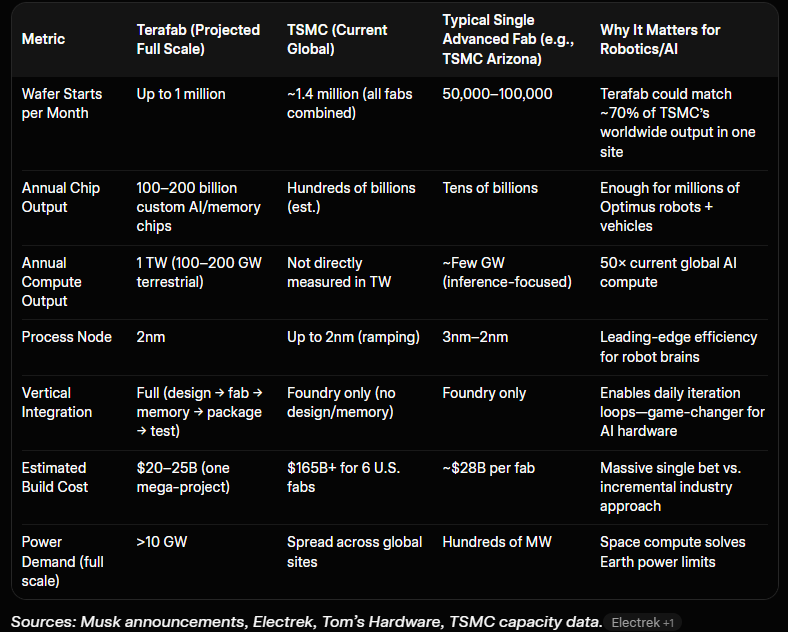
Comparison Table: Terafab vs. the Chip Industry Giants
Bonus Chip Performance Snapshot (Tesla’s roadmap claims): AI5 (Terafab target) is expected to deliver ~10× the performance of AI4 at similar power, with later gens pushing toward 40–50× overall compute gains vs. previous Tesla silicon—while aiming for roughly 1/3 the power draw of top NVIDIA inference chips for equivalent workloads. Exact figures will be validated only after silicon ships.
Tesla is clearly pivoting. While EVs remain core, Musk has repeatedly said the real prize is Optimus—potentially billions of units per year. Terafab is the silicon infrastructure bet that makes that possible. It’s Apple controlling its own A-series chips for iPhone, or NVIDIA owning the AI GPU stack—except applied to walking, working, general-purpose robots.
The Reality Check
If successful, Terafab doesn’t just solve supply shortages. It could create an entirely new economics of intelligence: cheap, abundant compute enabling robots that work alongside humans, orbital AI data centers cheaper than Earth-based ones, and a closed-loop “wattage-and-tonnage” economy Musk has hinted at.
This is classic Musk-scale ambition—and it comes with classic Musk-scale risks. Tesla has zero semiconductor manufacturing experience. Building a 2nm fab from scratch is “extremely hard” (even NVIDIA’s Jensen Huang has warned about it). Analysts note the real cost could balloon to $35–50B+, timelines will slip, and power/vibration/logistics challenges at Giga Texas are non-trivial. Past Tesla hardware promises (4680 cells, Dojo timelines) have faced delays.
Still, the signal is unmistakable: Tesla, SpaceX, and xAI are no longer waiting for the chip industry to catch up. They’re building the future’s compute layer themselves.