

In the Press - Ausbiz: The $1.7 trillion rocket ready for takeoff
9th April, 2026
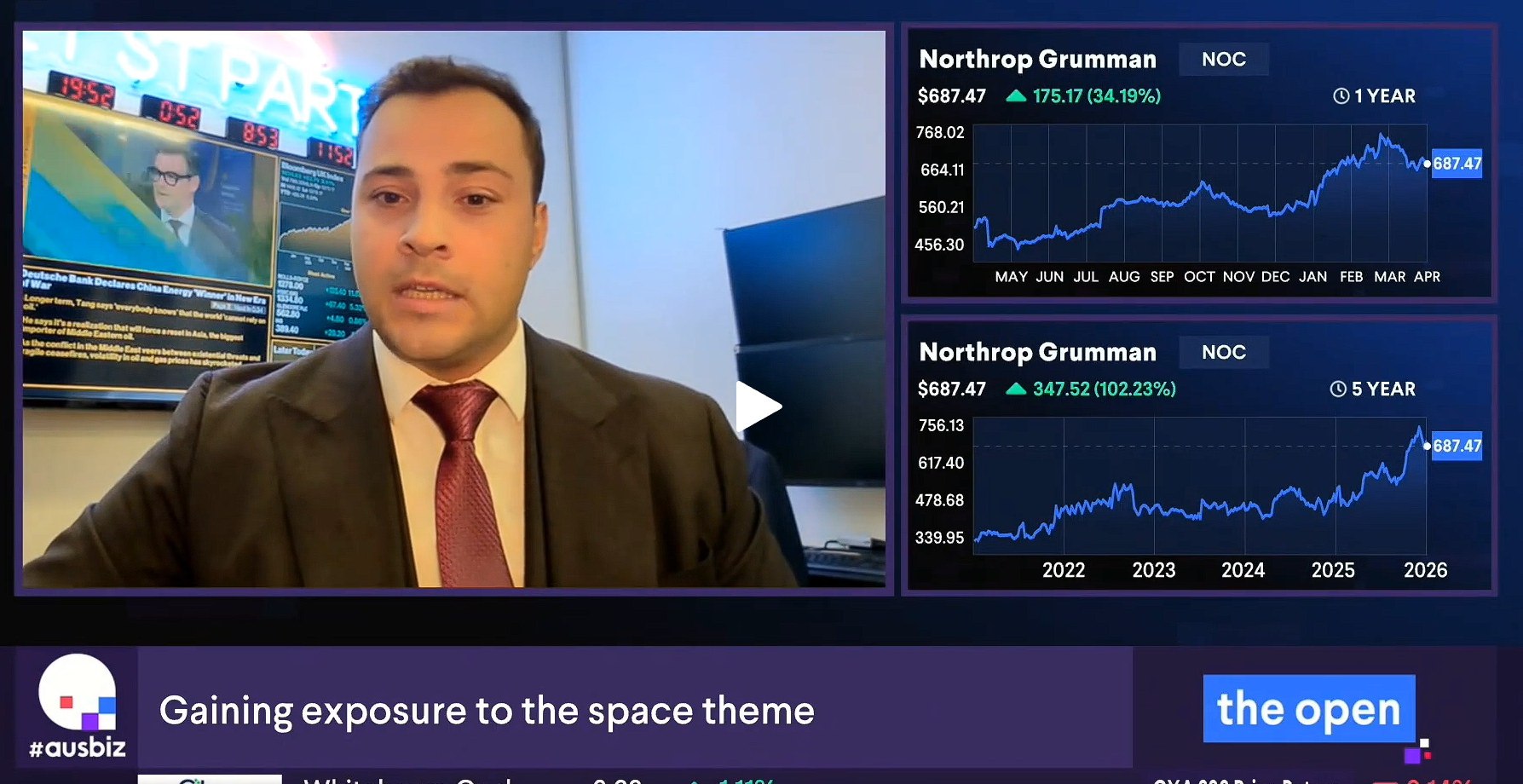
Daniel Reaper, Portfolio Manager, joined Ausbiz to discuss the renewed space race is emerging as a long-term investment theme, shifting from government-led to commercially driven projects. NASA’s Artemis programme aims to build a sustained lunar presence and cislunar economy, backed by bipartisan support. While prime contractors like Lockheed Martin, Boeing, and Northrop Grumman provide exposure, space-focused ETFs such as ARKX and UFO offer broader thematic access. A potential SpaceX IPO, valued at ~US$1.7 trillion, is highly anticipated but carries demanding valuations.
Watch Here: The $1.7 trillion rocket ready for takeoff
The New Space Race: Why the Moon Matters Again – And How Investors Can Play It
The Moon is back in the spotlight. With NASA’s Artemis II mission currently completing its historic crewed lunar flyby, the renewed space race is accelerating fast. At Grey Street Partners, we see this not as fleeting hype, but as a structural, long-term investment theme tied to technology dominance in a new era of geopolitical competition.
From Cold War Sprint to Strategic Marathon
The original Apollo program was a Cold War sprint — a “flags and footprints” mission born from the shock of Sputnik. America got there first in 1969, but didn’t stay.
Artemis is different. Launched under President Trump’s Space Policy Directive 1 and reinforced with bipartisan support, it’s a marathon focused on sustained human presence. The goal: establish a long-term outpost, particularly at the lunar south pole where water ice could enable life support and in-situ rocket fuel production.
This opens the door to the cislunar economy — genuine commercial activity in the space between Earth and the Moon. It’s no longer just exploration; it’s about building strategic advantage in what many view as a new Cold War centered on technology supremacy.
A New World Order Theme
This shift mirrors broader global dynamics: export controls on advanced chips, efforts to constrain rival technological ascent, and the symbolic power of dominating the next frontier. Even as administrations change, the institutional momentum behind American space leadership remains strong.
NASA now spends just ~0.4% of the federal budget (versus ~4% at Apollo’s peak). The gap is being filled by a vibrant commercial ecosystem — a key difference from the government-heavy Apollo era.
How Investors Can Gain Exposure
Investors seeking exposure have several routes, though none are perfect pure plays yet.
Prime Contractors Major players building core Artemis hardware include:
Lockheed Martin (LMT) — Orion crew capsule
Boeing (BA) — SLS core stage
Northrop Grumman (NOC) — SLS boosters and key Orion systems
Space-related work makes up roughly 20-30% of their revenue, but direct NASA contracts remain a small slice overall. These names also carry defence exposure, which raises ESG considerations for some portfolios.
Broader Thematic Access For more diversified exposure, we prefer space-focused ETFs:
ARK Space Exploration & Innovation ETF (ARKX)
Procure Space ETF (UFO)
These capture the wider ecosystem beyond just NASA contractors.
The SpaceX Factor: The Purest Play on the Horizon
No discussion of the new space race is complete without SpaceX. The company has revolutionized the industry with reusable rockets, now handling ~90% of global mass to orbit. It operates the world’s largest space-based internet network via Starlink and is developing the most powerful rocket ever in Starship.
SpaceX is expected to generate roughly $15-16 billion in revenue for 2025 with strong profitability (~$8 billion profit), driven largely by high-margin Starlink subscriptions (50-80% of revenue), plus launch services and government contracts.
The upcoming SpaceX IPO — potentially the largest in history — is generating enormous anticipation. Roadshow activity is ramping up, with a possible listing as early as June or July 2026. Valuation targets have been discussed in the $1.7–2 trillion range, which would place it immediately among the largest companies in the S&P 500.
A successful listing could validate the commercial space model, attract significant institutional and retail capital (with reports suggesting up to 30% retail allocation), and open the floodgates for the broader sector. While IPOs are often better liquidity events for early investors than ideal entry points for new ones, we’ll be watching closely.
Speculation around future synergies or even a merger with Tesla adds another layer of intrigue.
Our Current Stance
At Grey Street Partners, we currently have no direct exposure to the space theme. However, it is firmly on our watchlist as one of the most compelling megatrends of the coming decade. The combination of geopolitical drivers, commercial innovation, and potential for a genuine cislunar economy makes this a theme worth monitoring closely — especially as the SpaceX story unfolds.
The race to the Moon isn’t just about prestige anymore. It’s about building the infrastructure for humanity’s next chapter — and creating investable opportunities along the way.