


1st June, 2026
Daniel Reaper, Portfolio Manager, joined AusbizTV to discuss Structural labour shortages emerging as global population growth slowshow AI‑enabled humanoid robots as a response to a multi‑trillion‑dollar labour shortfall and positioned to address productivity gaps.
Watch Here: Three ways to invest in humanoid robotics
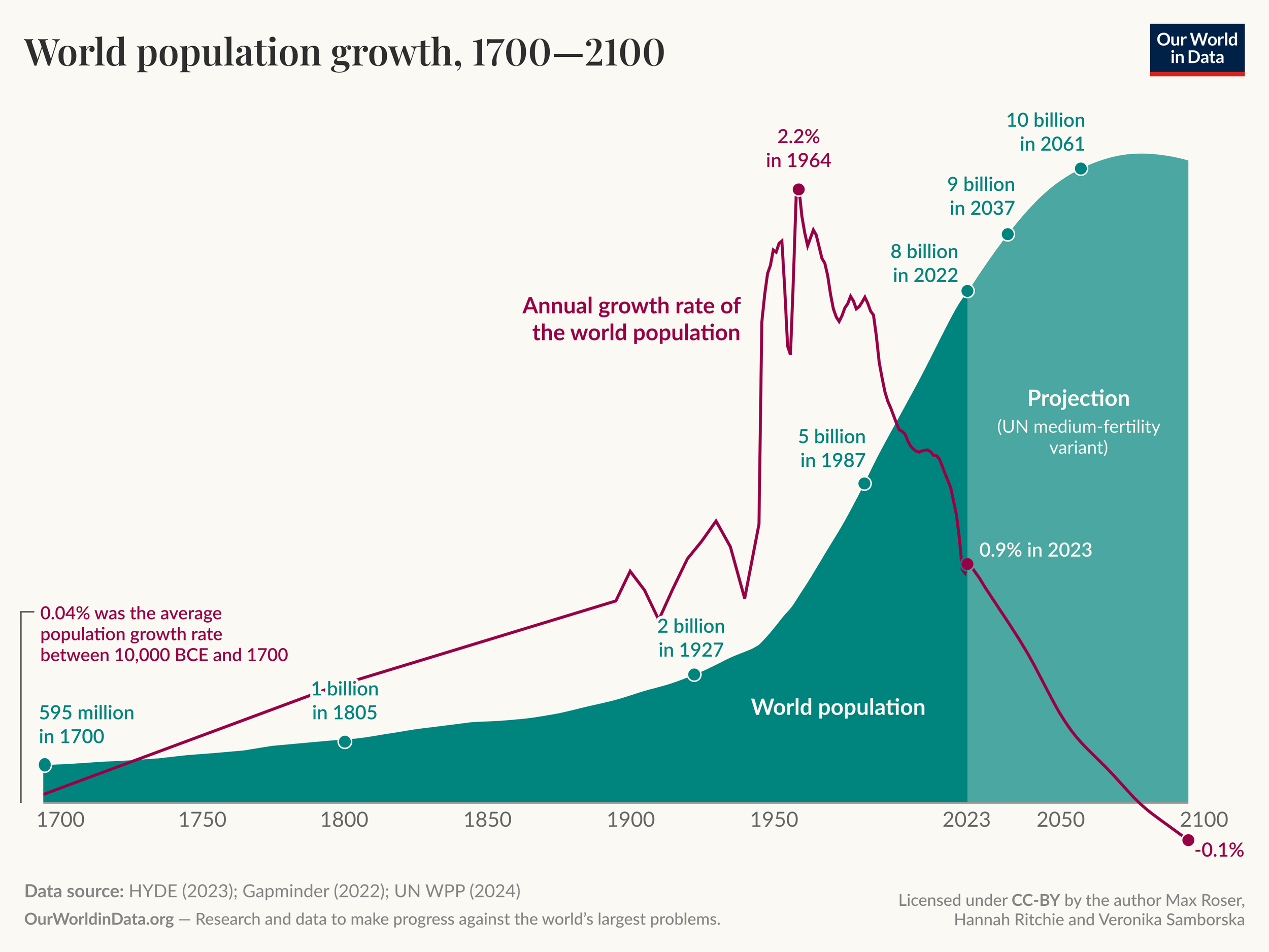
The Silent Crisis No One Is Talking About: Shrinking Populations
For years we’ve been told the world’s biggest problem is too many people. The reality is almost the opposite. Global population is projected to peak at around 10.3 billion in the mid-2080s before entering a slow but persistent decline, according to United Nations forecasts. More than 80 countries, representing 46% of the world’s population, already have fertility rates below the replacement level of 2.1 children per woman. When fertility stays below that threshold, populations don’t just stop growing. They shrink. And when they shrink, the workforce shrinks with them.
The Workforce Cliff Is Already Here
Japan (fertility ~1.2): facing a 40% reduction in its workforce by 2050.
China (fertility near 1.0): already has 23% of its population aged 60 or older. The infamous “4-2-1” family structure means one young worker is often expected to support two parents and four grandparents.
Europe: expects a 10% workforce decline by 2030. Germany alone will be short 3 million workers by 2035.
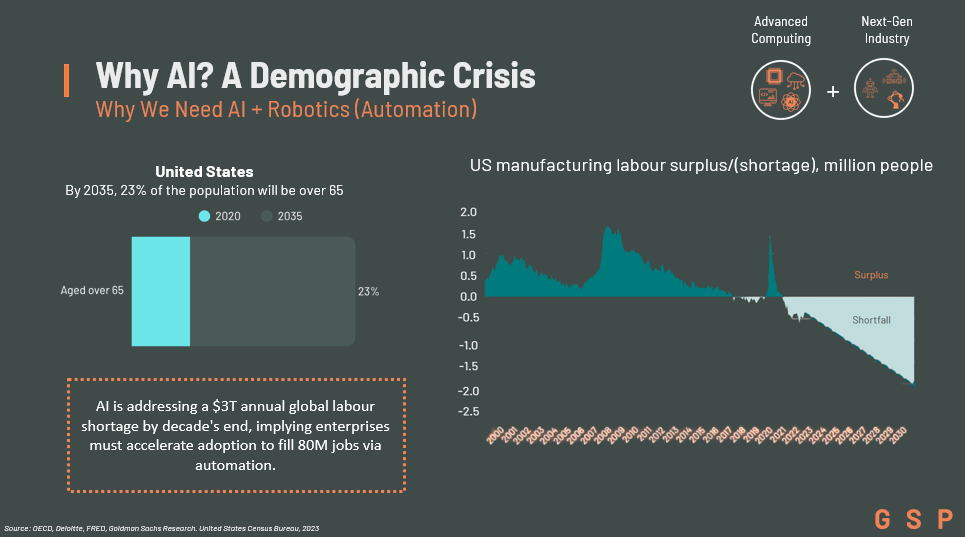
United States (fertility 1.6): 23% of the population will be over 65 by 2035.
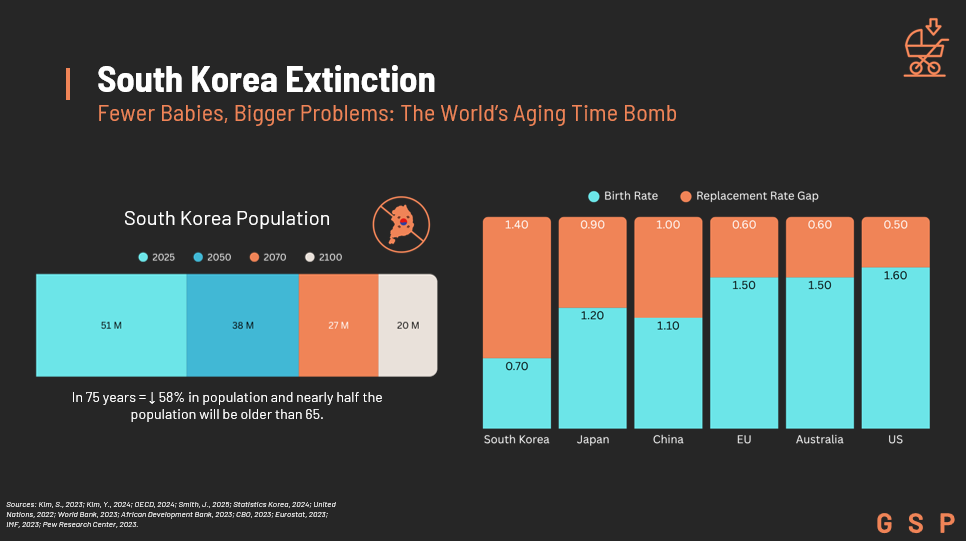
South Korea (fertility 0.7 — the lowest in the world): its population is expected to collapse from 58 million today to around 20 million in 75 years, a 58% decline. (See Slide below for illustration)
The numbers are brutal. Economists project this imbalance will create a $3 trillion+ annual global labor shortage by the end of this decade, equivalent to roughly 80–85 million unfilled jobs and trillions of dollars in lost economic output every single year.
If there aren’t enough people producing goods and services, GDP growth collapses. That’s not a theory. It’s arithmetic. Hence the opportunity.
The Solution Already Exists: AI-Powered Humanoids
To every structural problem, there is eventually a technological solution. In this case, it’s humanoid robots powered by modern artificial intelligence.
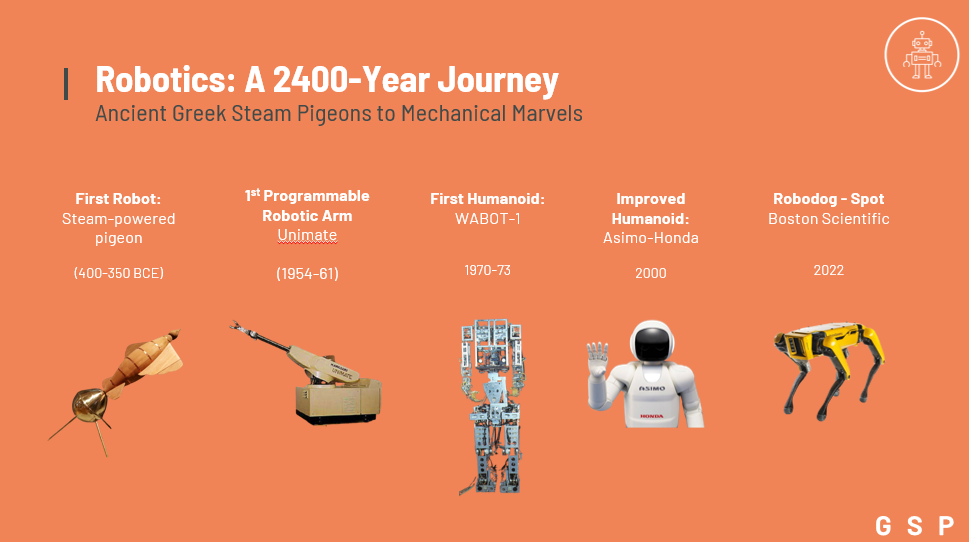
Humanoid development has been underway for decades. Japan built the first humanoid, WABOT-1, in the 1970s. Honda advanced the field dramatically from the mid-1980s. Boston Dynamics (now part of Hyundai) brought dynamic movement and real-world utility into the public consciousness with Spot.
What was always missing was intelligence. Without AI, robots could only perform narrow, pre-programmed tasks. With modern AI, they can be trained, adapt to new situations, and improve over time, exactly like software.
Today’s humanoids are still early, much like the original iPhone in 2007. Current capabilities include folding laundry, loading dishes, and cleaning rooms. But the trajectory is clear: within a few years we will see meaningful deployment across agriculture, manufacturing, logistics, healthcare, and eldercare.
The total addressable market (TAM) is enormous. With ~80 million unfilled jobs globally and humanoid hardware targeting ~$20,000 per unit, the hardware opportunity alone exceeds $1.6 trillion. The software and services layer on top of that will be worth far more.
China vs the United States: Volume vs Intelligence
The race to deploy humanoids at scale is already underway and it has two very different leaders.
China currently dominates volume. In 2025, Chinese manufacturers accounted for an estimated 80–90% of global humanoid shipments (out of roughly 13,000–14,000 units total). Companies like Agibot (over 5,000 units) and Unitree (around 5,500 units) are shipping aggressively at prices often under $20,000.
China even held a humanoid robot half-marathon in 2025. The winning robot finished in just over 50 minutes, a massive improvement from the previous year’s winning time of 2 hours and 40 minutes. Progress is extremely rapid.
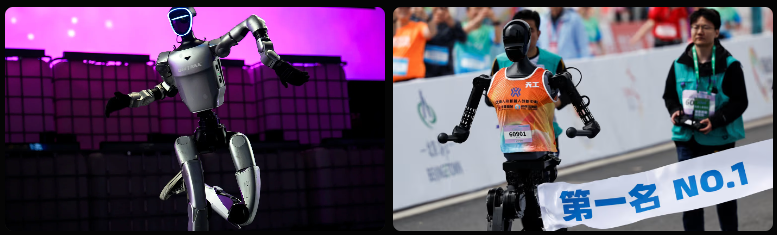
The United States, by contrast, leads in advanced AI and software intelligence.
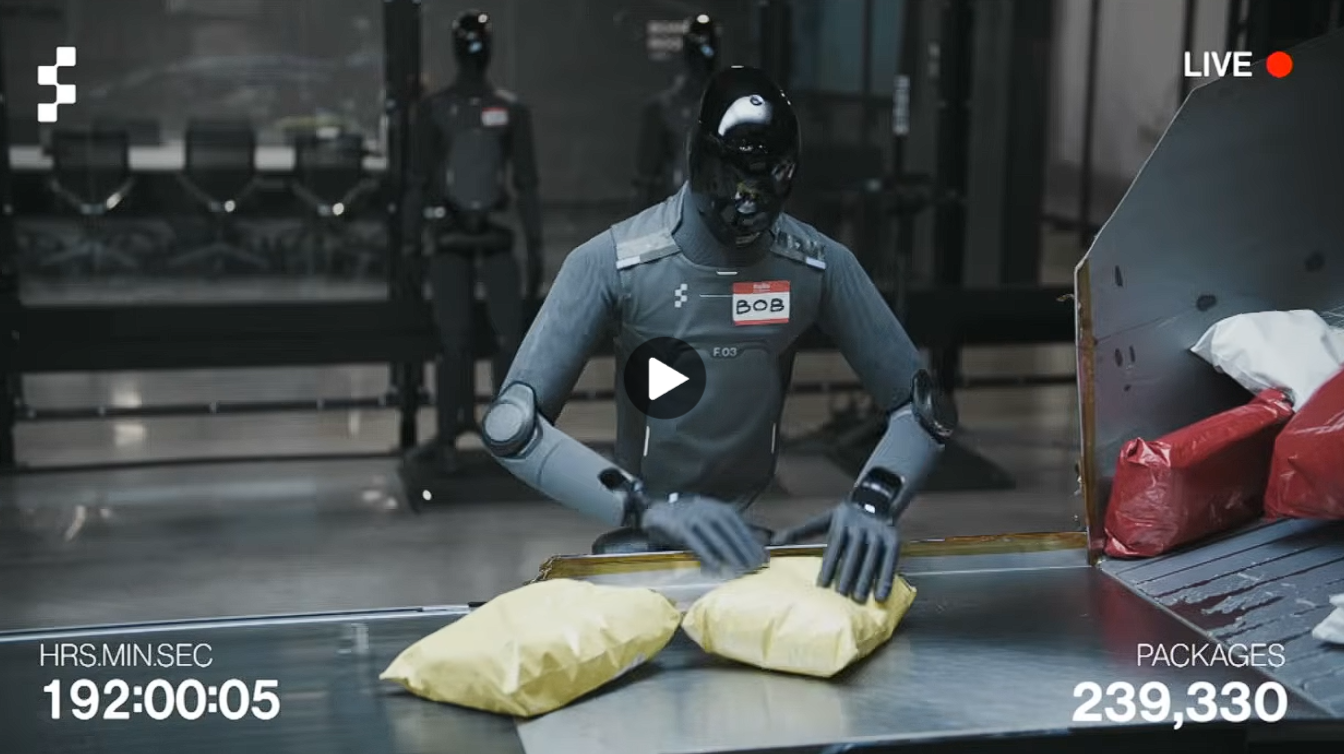
A standout recent example came from Figure AI. In a warehouse test, their Figure 03 robots were supposed to run for 8 hours sorting packages. Instead, they operated autonomously for 200 hours straight (over eight days), sorting nearly 250,000 packages at near-human speeds with zero major hardware failures. That demonstration showed these machines can already perform economically valuable work that directly replaces human labor. Figure AI remains private, which limits investor access. That makes Tesla the clearest public pure-play in the humanoid space.
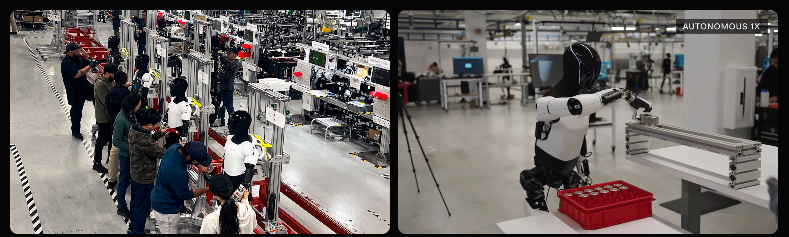
Tesla is already testing its Optimus Gen 3 inside its own factories and plans o begin meaningful external production this summer, with a goal of scaling to tens of thousands of units over the next 12–18 months. The company has broken ground on a dedicated Optimus factory at Gigafactory Texas with long-term capacity targeting millions of units per year.
Initial pricing is targeted in the $20,000–$30,000 range. Elon Musk’s long-term vision is even more ambitious: ultimately producing billions of Optimus robots globally, essentially one for every human who wants one.
Critically, Tesla is not just building hardware. It is building a high-margin AI and software platform on top of the robot. This opens the door to recurring revenue models such as Robot-as-a-Service (RaaS), similar to how the company monetizes vehicles and Full Self-Driving software today.
How Investors Can Actually Get Exposure
Beyond Tesla, there are several ways to gain exposure to this theme:
Semiconductors — The picks and shovels. A company like ARM has noted that a humanoid robot contains roughly 8–10x more chips than a smartphone. The computational demands are significant.
Batteries and energy systems — Humanoids will need dense, long-duration power sources.
Thematic ETFs — Funds such as HUMN and ROBO provide diversified exposure to robotics and automation companies.
We are still in the very early innings. The demographic problem is structural and accelerating. The technological solution — AI-driven humanoids — is finally becoming practical and scalable.
The countries and companies that successfully deploy this technology at scale will gain a meaningful productivity advantage. The ones that don’t will face slower growth and rising dependency ratios.
This isn’t about replacing humans for the sake of it. It’s about solving a mathematical problem that will otherwise constrain living standards across the developed world for decades.
The opportunity is real, it’s large, and it’s still early.