

Mini Series: A New World Order - A challenge to the USD Reserve Currency
Right now, the headlines are loud: “The U.S. Dollar is dying.”
BRICS nations are buying gold at record levels.
Spot gold briefly pushed above $5,600 per ounce in 2026.
Discussions of alternative payment systems and even a shared settlement currency to bypass the U.S.-centric financial system are everywhere.
It sounds dramatic. It sounds imminent.
But the reality, when we step back, is more nuanced.
The Data Doesn’t Lie
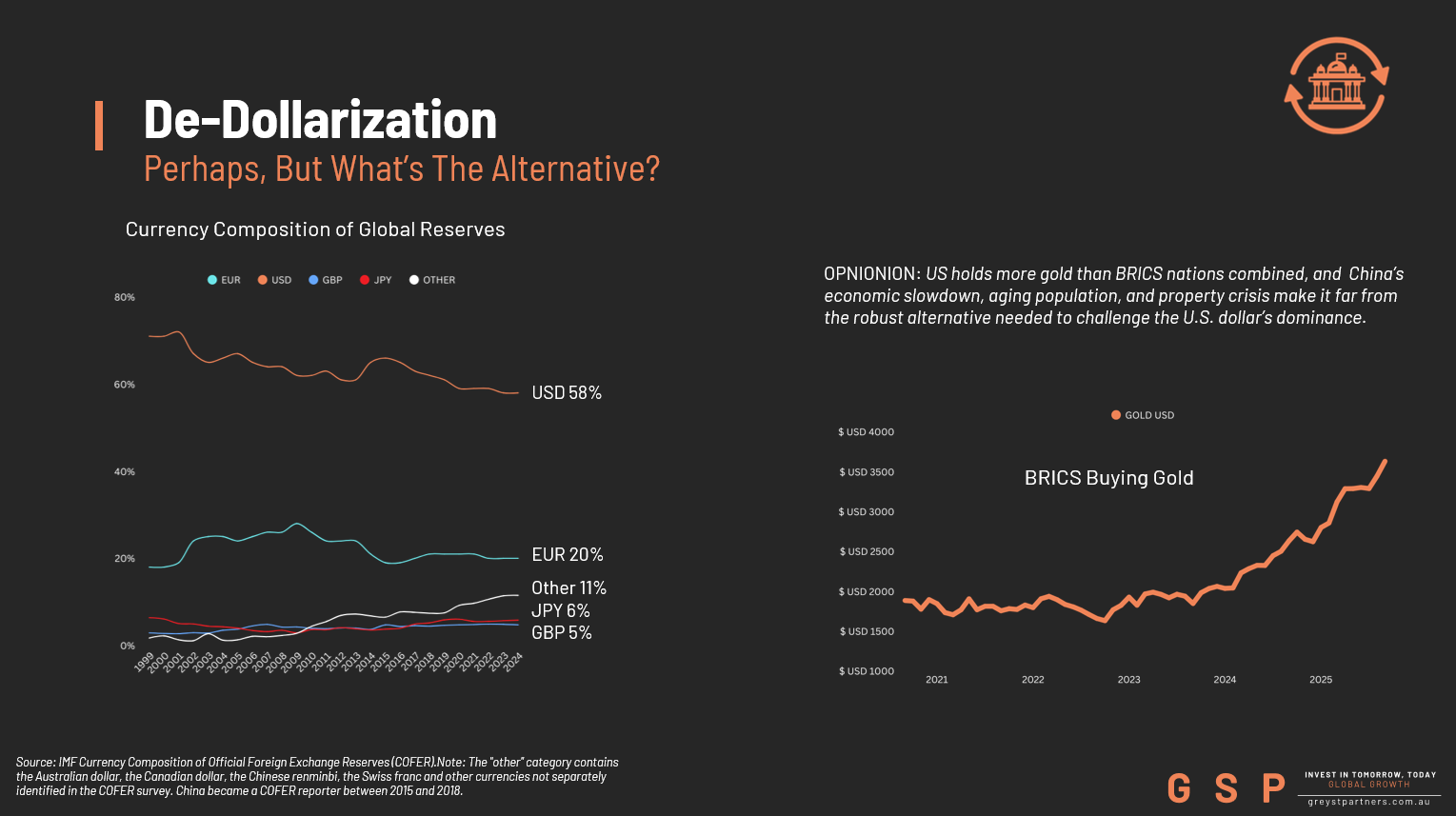
Despite the headlines, the dollar remains overwhelmingly dominant:
In 2025, 58% of global foreign exchange reserves were held in U.S. dollars.
The Chinese yuan? Under 3%.
Global trade is still largely invoiced in dollars.
Energy markets remain dollar-denominated.
Debt markets are heavily dollar-based.
Reserve currency status isn’t about media narratives. It’s about infrastructure:
The deepest and most liquid bond market in the world — U.S. Treasuries.
Rule of law and enforceable property rights.
Open capital markets attracting global liquidity.
A military presence that underwrites trade routes.
A financial plumbing system spanning every continent.
Even gold doesn’t fully challenge this dominance. The U.S. still holds more official gold reserves than any individual BRICS member — combined.
History Shows It’s a Long Slope, Not a Cliff
History offers a clear lesson: global reserve currencies are rarely replaced suddenly.
The British pound did not collapse overnight when the U.S. rose. It eroded over decades as economic gravity shifted.
This is what de-dollarization looks like in practice: not a cliff, but a slope.
Yes, the world is diversifying.
Yes, bilateral trade agreements increasingly settle in local currencies.
Yes, gold accumulation signals a desire for optionality.
But diversification is not displacement. The dollar remains deeply embedded in:
Global banking systems
Derivatives markets
Cross-border lending
Central bank swap lines
Corporate balance sheets
You cannot unwind that architecture in a few years.
Structural Advantages of the Dollar
Reserve currency status isn’t just economics — it’s power.
The U.S. dollar isn’t backed by gold.
It’s backed by the full faith and credit of the United States, and the global reach of the U.S. Department of Defense.
Until another nation can underwrite global trade routes, secure capital flows, and project force at scale, there is no true alternative.
Even rising powers like China push for alternatives — yuan settlements, digital currency experiments, Belt and Road trade agreements denominated in local currencies — but they face structural barriers:
Limited global trust in financial infrastructure
Small relative bond markets
Lower legal enforceability and market openness
Military and geopolitical reach still inferior to the U.S.
Lessons from Empire History
The decline of a reserve currency has historically marked an empire’s waning influence:
Dutch Empire (17th-18th Century): The guilder backed by Amsterdam’s financial dominance faltered due to wars, debt crises, and British competition.
British Empire (19th-20th Century): The pound sterling declined after World War I and II, eventually replaced by the U.S. dollar at Bretton Woods in 1944.
The pattern shows that losing reserve currency status is gradual, not sudden — decades of structural shifts, not years of headlines.
Where Does This Leave Us?
The dollar faces challenges — diversification, gold accumulation, and alternative payment systems are real signals of shifting global dynamics.
But the U.S. dollar remains dominant because:
The bond market depth can absorb global savings.
The military and geopolitical network secures global trade.
Capital markets and financial infrastructure are unmatched.
De-dollarization is happening slowly, incrementally, and selectively — not as a sudden displacement of U.S. global financial primacy.
At the end of the day, reserve currency status is a marker of both economic and strategic power. And for now, the U.S. remains firmly at the centre of that system.