

Mini Series: What's Happening with South Koreas' Stock Market?
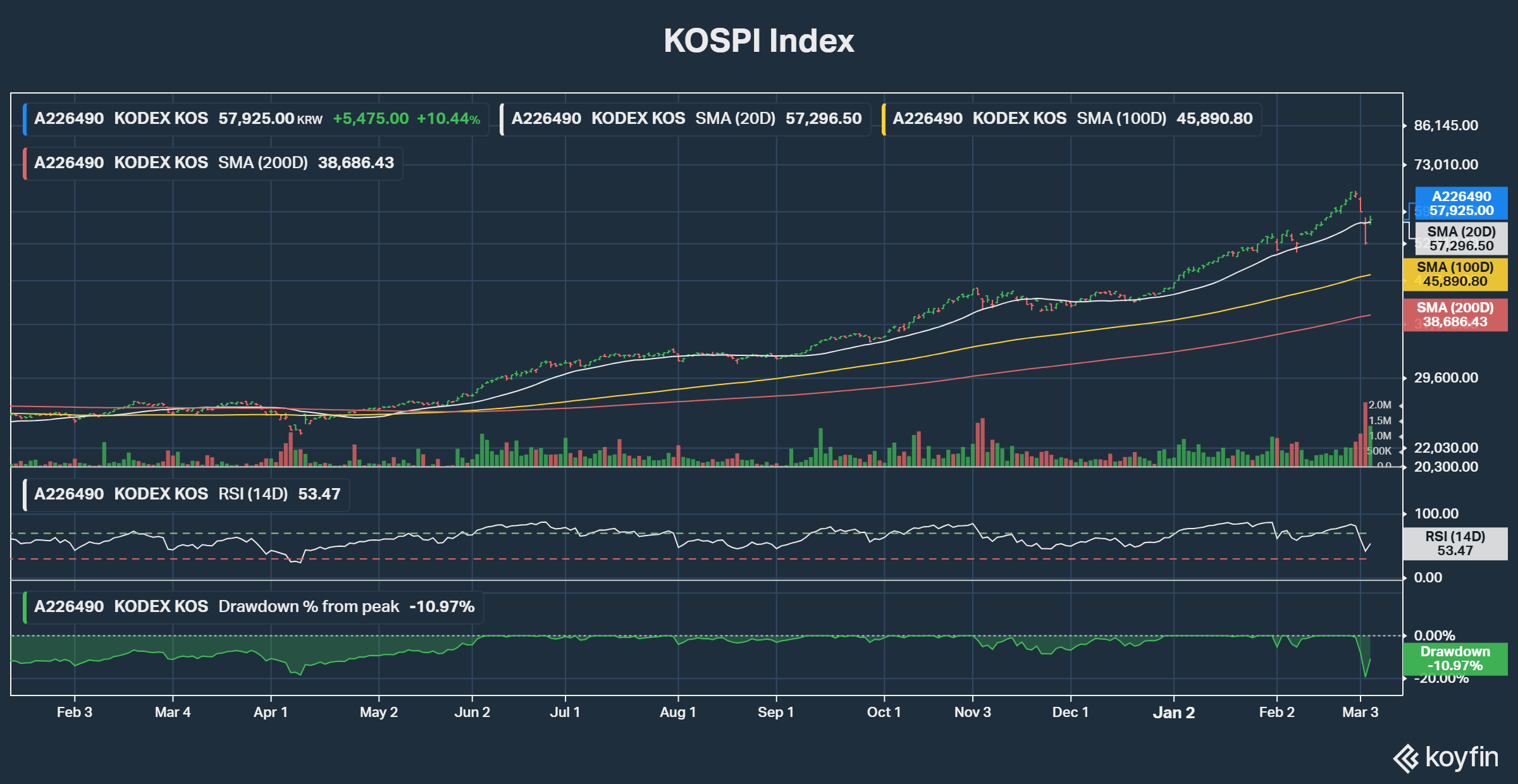
the KOSPI experienced one of the sharpest sell-offs seen in years.
The index plunged nearly 20% in just a few days, wiping out hundreds of billions of dollars in market value and triggering market circuit breakers designed to halt panic selling. Then almost as quickly as it fell the market rebounded.
The damage was concentrated in South Korea’s technology giants:
Samsung Electronics fell more than 10%
SK Hynix dropped over 12%
South Korea’s Critical Role in the AI Boom
To understand why the market reacted so violently, you need to understand South Korea’s position in the semiconductor ecosystem.
Companies like Samsung Electronics and SK Hynix dominate the global memory market.
Together they control roughly:
Two-thirds of global DRAM production
Nearly 80% of high-bandwidth memory (HBM)
DRAM — Dynamic Random-Access Memory — is a fundamental component used across computers, servers, and data centers.
HBM, however, has become even more strategically important.
It is a critical layer of modern AI infrastructure.
The world’s largest AI systems depend on it, including:
GPUs from NVIDIA
TPUs from Google
Massive hyperscale clusters built by companies like Amazon and Microsoft
Put simply:
The AI boom runs on memory and much of that memory comes from South Korea.
The Hidden Weakness: Energy
Here’s where things get interesting.
Despite its dominance in semiconductors, South Korea imports roughly 97% of its energy.
Much of that energy supply flows through one of the most strategically important shipping routes in the world:
Strait of Hormuz
This narrow waterway — only about 21 miles wide at its narrowest point — is responsible for transporting a large share of the world’s oil and liquefied natural gas.
It is also one of the most geopolitically sensitive chokepoints on Earth.
Any disruption there has immediate consequences for global energy markets.
And for South Korea, that means something critical:
Energy security directly affects semiconductor production.
Why This Matters for AI
Semiconductor fabrication plants are among the most energy-intensive facilities in the world.
Memory fabs in particular require:
Massive uninterrupted power (known as ‘UIP’)
Perfectly stable electricity supply
24/7 operations
Even short disruptions can force production slowdowns.
And here’s another problem: memory inventories are extremely thin.
Typical global inventory levels are estimated at:
DRAM: roughly 2–3 weeks
NAND: around 3–4 weeks
That means the system has very little buffer.
If energy flows were disrupted for a month or longer, it could quickly ripple through the global semiconductor supply chain.
In a worst-case scenario, it could even stall parts of the global AI buildout.
Why the Market Panicked
The biggest risks to major technological revolutions don’t always come from the obvious places.
The AI boom isn’t just about:
GPUs
Data centers
software models
or venture capital
It also depends on physical infrastructure.
Energy. Shipping routes. Supply chains.
And when 80% of the world’s AI memory is produced in a country that imports 97% of its energy through a geopolitical chokepoint - The Straight of Hormuz,, the system suddenly looks a lot more fragile.
What Triggered the Rebound
Then the market suddenly reversed.
The rebound came after comments from Donald Trump, who stated that the United States would ensure safe passage for oil tankers and cargo vessels through the Strait of Hormuz.
The proposal reportedly included:
Naval protection for shipping routes
Insurance guarantees for cargo vessels
Measures aimed at keeping global energy flows stable
Those comments helped calm oil markets and reduce fears of a prolonged energy disruption.
Asian equities quickly bounced — including the KOSPI.
The Question Investors Are Now Asking
Was this simply a short-term panic, or the market briefly recognizing a real structural risk?
It’s impossible to know yet.
But one thing is becoming clear:
The AI revolution may have a hidden single point of failure — and it might not be chips.
It might be energy.