

Mini Series: A New World Order: Political Polarization - Socialists vs Capitalists)
A Nation Split Down the Middle
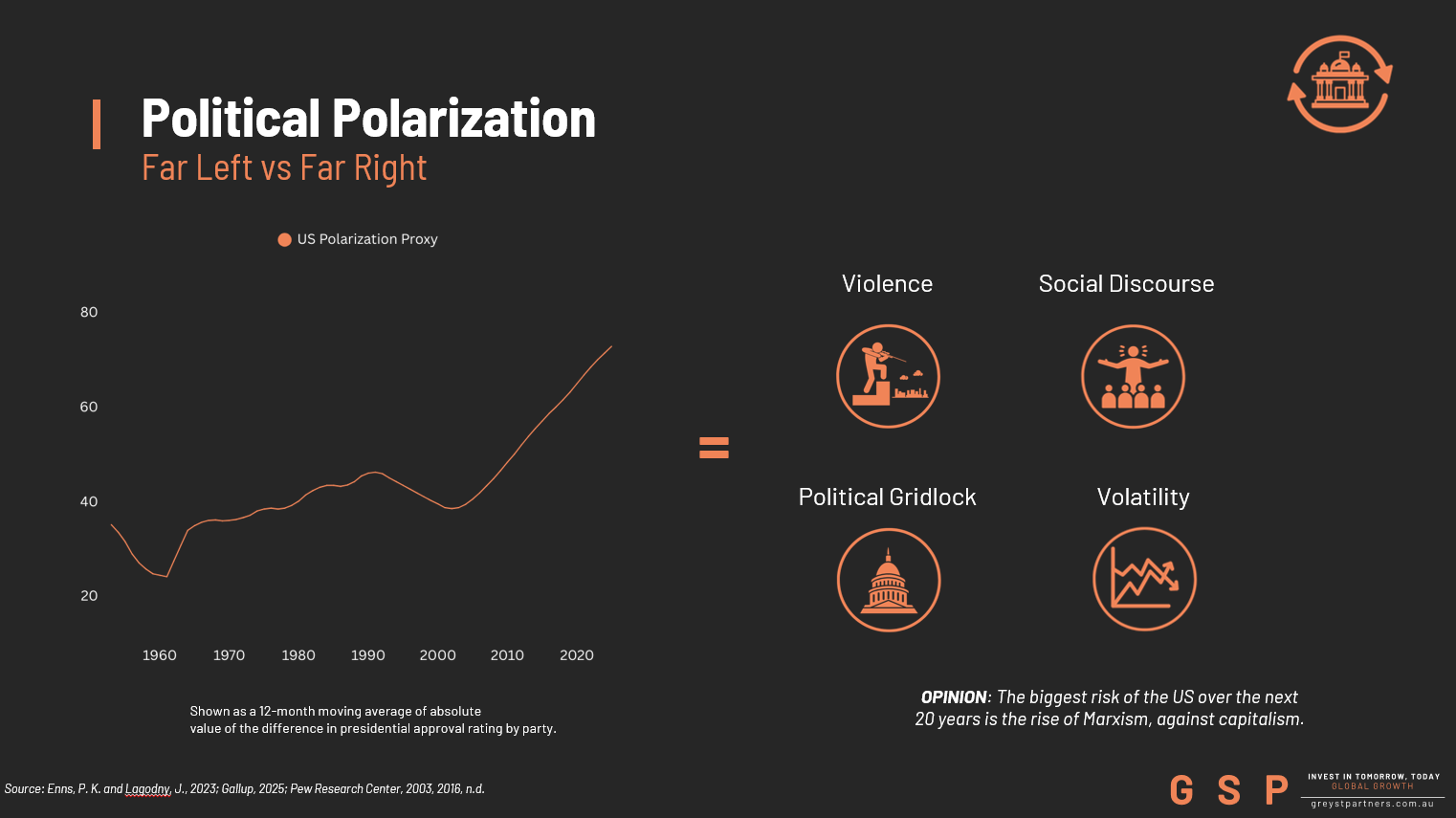
Presidential approval gaps between parties have approached historic highs. Ideological sorting has intensified. The political centre has thinned as both the progressive Left and populist Right gain energy and visibility.
Part of this shift includes renewed interest in socialist frameworks and critiques of capitalism, particularly in debates over:
Wealth inequality
Labour rights
Corporate power
Healthcare and education
The role of the state in economic outcomes
These currents are reshaping discourse inside the United States, challenging post-Cold War assumptions about markets, globalisation, and liberal democracy.
At the same time, populist nationalism has strengthened on the Right, with sharper rhetoric around sovereignty, immigration, and cultural identity.
The result is friction — cultural, economic, and institutional.
Wealth Gaps and Social Strain
Rising inequality has widened the perception gap between economic winners and those who feel left behind. Asset inflation over the past decade disproportionately benefited capital holders. Meanwhile, real wage growth for many households lagged housing, healthcare, and education costs.
Historically, widening wealth gaps often precede political instability. Citizens begin questioning whether the system is delivering broadly shared prosperity.
This fuels ideological competition:
Capitalism versus state-led redistribution.
Globalism versus sovereignty.
Institutional trust versus institutional scepticism.
The debate is not subtle anymore. It is loud, public, and constant.
Gridlock: Weakness or Stability?
Polarization often leads to legislative gridlock. Compromise becomes rarer. Major bills become more sweeping and high-stakes because incremental policymaking stalls.
From a governance standpoint, this slows decision-making.
From a market standpoint, however, gridlock can paradoxically create stability. Markets tend to prefer predictability. When sweeping reforms are unlikely to pass, the status quo can feel safer for capital allocation.
So polarization does not automatically translate into economic collapse. In some cases, it produces inertia — and inertia can be stabilising.
But long-term gridlock can erode public trust if citizens feel the system no longer functions effectively.
Violence and Escalating Rhetoric
One concerning feature of heightened polarization is the shift in tone.
Political rhetoric has grown sharper. Opponents are framed less as rivals and more as existential threats. In this environment, isolated acts of political violence — or alleged attempts — become amplified symbols of deeper division.
When media ecosystems reinforce echo chambers, trust deteriorates further. Each side views the other not merely as wrong, but dangerous.
That is historically the moment when polarization becomes corrosive rather than competitive.
And Yet — Global Assertiveness Remains
Here’s the nuance.
Despite intense internal debate, the U.S. remains active and assertive abroad.
From strategic competition with China to tensions involving Iran and Venezuela, American foreign policy remains engaged.
Military alliances hold.
Sanctions regimes remain operational.
Trade policy remains strategic.
Historically, empires do not collapse the moment internal division rises. Often, they continue projecting power externally while negotiating domestic tensions.
This mirrors what political scientists describe through frameworks like the Thucydides Trap — when a rising power challenges an established one, increasing the risk of confrontation. The structural rivalry persists even if the incumbent is internally divided.
Resilience Under Pressure
Democracies are noisy by design.
Public disagreement is visible.
Debates are messy.
Policy swings with elections.
But that transparency can also be adaptive.
Societies that debate identity, sovereignty, and economic direction openly are not necessarily in decline. They may be recalibrating.
If one believes current leadership is a major driver of polarization, electoral cycles remain a moderating mechanism. Political systems evolve. Leadership changes. The centre can re-emerge over time.
The question is whether institutions remain strong enough to manage the tension without fracturing.
So far, despite record-high polarization, the institutional core of the U.S. — courts, military, capital markets, and federal structures — remains intact.
Decline or Rebalancing?
Is polarization a sign of imperial decline?
Or is it the growing pain of a society adjusting to:
Shifting global power dynamics
Technological disruption
Demographic change
Wealth concentration
A post-World War II order under strain
Internal division is real.
Ideological extremes are louder.
Economic anxiety is tangible.
But resilience is also visible.
The United States remains the largest economy in the world.
It issues the global reserve currency.
It maintains deep capital markets and global alliances.
This story is not simply one of collapse.
It may instead be one of resilience under pressure — a system stress-tested in public view.